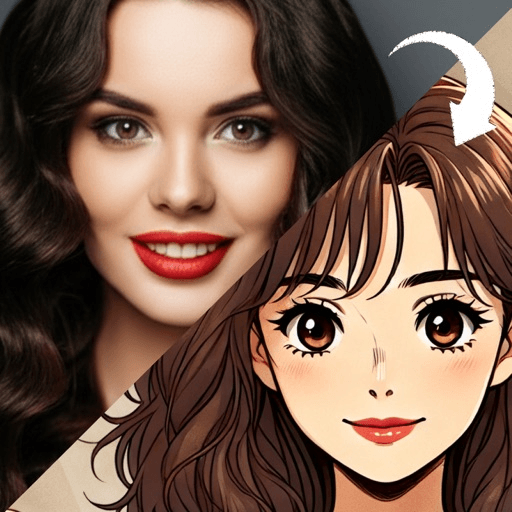
Chibi is a Japanese art style, also called super deformation, in which a character is drawn small and rounded with an oversized head, oversized eyes, a tiny nose, stubby limbs and very little detail. The head takes up between a third and half of the total height, so the figure ends up roughly two to three heads tall.
That is the whole definition, and it is unusually precise for an art style. Chibi is not a mood or a palette. It is a set of measurements, and once you know them you can spot the style instantly and predict what it will do to a face.
Where does the word chibi come from?
The English term comes from the Japanese chibi kyara, meaning tiny character. Chibi on its own is a colloquial word for very short people and for children, and it derives from a verb meaning to wear down. Kyara is borrowed straight from the English word character.
The other name for the same style, super deformed, usually shortened to SD, is a translation of the Japanese deforume, meaning stylistic distortion, which in turn came into Japanese from the French déformer. So both names describe the same operation from different directions: one says small, the other says deliberately distorted.
That second word matters, because deformation here is a technique rather than an accident. Tate’s definition of caricature is a drawing in which the features and form have been distorted and exaggerated, and chibi is that idea applied with a fixed ratio instead of by eye.
What are chibi proportions, exactly?
A typical anime character is usually drawn about seven to eight heads tall, which is close to the proportion used in figure drawing generally. A super deformed character is drawn so that the head is normally somewhere between one third and one half of the character’s total height.
Do the arithmetic and that lands at about two to three heads tall. Everything follows from that one number:
- The body becomes a small rounded shape with no real waist.
- Limbs shorten into stubs, and the joints stop being drawn at all, because there is not enough length to show a knee or an elbow.
- The nose shrinks to a mark or disappears.
- The eyes grow until they take up most of the face, since the face is now the majority of the picture and the eyes have to carry the expression on their own.
It is worth noticing what this does to the center of gravity of the image. In a full-length drawing your face is a small part of the frame. In a chibi drawing your face is most of the frame. That is why the style works so well at avatar size and so poorly as a full-body portrait.
What gets thrown away, and what gets kept?
Super deformed characters carry much less detail than their normally proportioned versions. Folds in a jacket are ignored. General shapes are favored over specifics. Texture mostly disappears and color goes flat and bright.
But the simplification is not uniform, and this is the part people miss. When a character is redrawn in super deformed form, some aspects of the design are simplified while others are pushed harder, and a signature characteristic, unusual hair or a particular accessory, will typically be made prominent rather than dropped.
That selective keeping is what makes a chibi version recognizable at all. Strip everything, then let one or two chosen things survive at full strength. If you wear distinctive glasses, they will get bigger, not smaller.
The style also inherits the broader habits of the medium it comes from. The Victoria and Albert Museum describes manga art as tending to focus on line over form, using lines to express movement and shadow, and notes that manga backgrounds are often impressionistic with more emphasis placed on the characters. Chibi takes that to its limit: the background is usually a flat color or nothing at all, and every drawing decision serves the figure.
What does chibi do to an actual selfie?
Three things, predictably.
It enlarges your head and shrinks everything below the neck, so whatever is in your photo below the collarbone stops mattering. It replaces your skin rendering with flat bright color and a single soft shadow, so shadows and blemishes both vanish. And it pushes your most distinctive feature forward while smoothing the rest, which is why chibi versions of people tend to read as friendly rather than as accurate.
Faces with a strong, simple silhouette do best: clear hair shape, visible eyes, an open expression. Faces photographed at an angle, in low light, or partly covered do worst, because the style has almost no surface detail to fall back on once the proportions are changed. The chibi avatar page sets out the look feature by feature along with how to shoot for it.
If you want the short version: shoot from chest height, straight on, with your whole head visible and a little space above your hair. The general rules in how to turn a photo into a cartoon apply here too, just more strictly, because a style with this little detail is less forgiving than most.
How is chibi different from the looks near it?
Four neighbors get confused with it regularly.
An anime style filter keeps human proportion and changes the surface: flat skin tone, one hard-edged shadow, hair in a few large shapes. Chibi changes the proportion and only then simplifies the surface. That is the whole difference, and it is a big one.
A manga style portrait moves the image into printed black, white and gray, where line weight and dot screens do the work. Chibi is usually flat and bright in color. The two can be combined, but they are separate decisions.
A 3D cartoon avatar also enlarges the head, which is why people mix them up, but it builds a lit, sculpted surface with visible highlights instead of a drawn outline. It reads as a figure you could pick up. Chibi reads as a drawing.
A caricature exaggerates what is specifically distinctive about your face while leaving human proportion roughly intact. Chibi applies the same ratio to everyone. A caricature of two different people looks like two different exaggerations; a chibi of two different people looks like two versions of the same template with different hair.
Cubes are another route to a simple, readable face. Voxel art builds the image from visible blocks instead of a drawn outline, and the size of the block decides how much of the face survives.
Is chibi a good choice for a profile picture?
For a small avatar, it is one of the best available. The style is widely read as cute, which is part of why it spread so far beyond its original medium, and a face that occupies most of the frame is exactly what survives being shrunk to a small circle. For more directions to take a small round avatar, see these cartoon profile picture ideas.
It is a poor choice when you want to be taken seriously in a professional context, and a poor choice for a full-body image. Those are not flaws in the style, they are just the edge of what a two-heads-tall figure can do.
Toonsta does not currently ship a dedicated chibi style. What it does ship that lands nearest is the anime style filter, which shares the flat color, the large simplified eyes and the reduced nose and mouth while keeping normal proportion, and the 3D cartoon avatar, which gives you the enlarged head in a sculpted rather than drawn register. New styles are added over time. If the chibi ratio is specifically what you are after, try both on the same photo and see which half of the look you actually wanted.