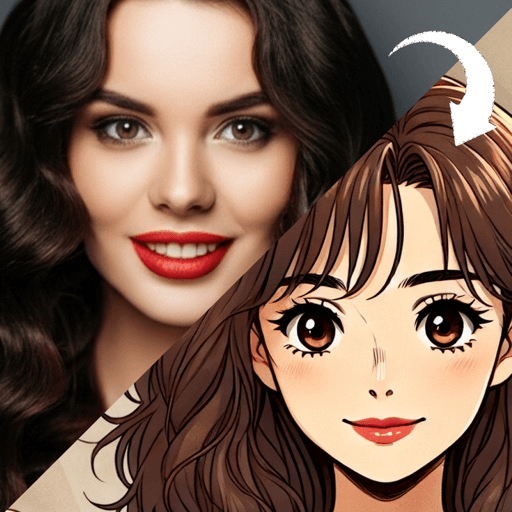
The look
- Flat skin tone with one hard-edged shadow shape, not a gradient.
- Hair grouped into a few large locks with a glossy highlight band.
- Large eyes with layered iris color and a white catchlight.
- A short nose line and a small simple mouth.
- A clean ink contour of even weight over a softly painted background.
Where it comes from
Anime grew out of Japanese cel animation. Britannica describes it as a style of animation popular in Japanese films, heavily influenced by manga and often combining colorful drawings with action-packed plots, and notes that the large eyes of anime characters are commonly read in Japan as windows to the soul. The BFI's history of television anime treats the small screen as the commercial engine of the industry, where long-running series are priced low and carry the franchises. What a still portrait copies is the drawn grammar itself: flat color areas, one hard shadow edge, and the expression concentrated in the eyes.
What it suits
- A profile picture for social and gaming accounts
- Matching portraits for two people
- Convention badges and print-outs
- Phone and desktop wallpapers
How to shoot for it
- Use one clear light source so the filter has a single shadow edge to place.
- Shoot from just above eye level, which suits the enlarged-eye proportion.
- Keep hair loose and visible; it is grouped into shapes and carries the likeness.
- Plain or softly blurred backgrounds convert better than busy interiors.
Related styles
- Manga style portrait: A manga style portrait redraws you as a printed comic page rather than a color illustration.
- Storybook illustration: A storybook illustration turns your photo into a picture book page: warm painted color, a soft drawn outline, and a scene built around you rather than a cropped background.
- Chibi avatar: A chibi avatar shrinks you to about two heads tall.