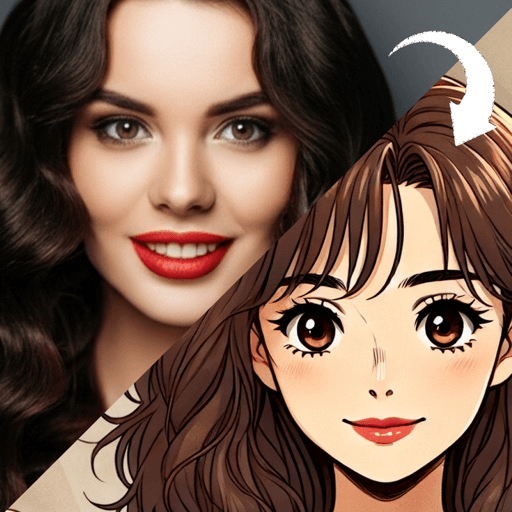
The look
- Rounded, sculpted volumes with no drawn outline anywhere.
- Large eyes and a slightly oversized head above smaller shoulders.
- Soft specular highlights on the nose, cheeks and lower lip.
- Hair modeled as one shaped mass with carved grooves rather than individual strands.
- Even studio-style key light with a soft shadow under the chin.
Where it comes from
The look comes from 3D computer graphics rather than from drawing. A character is built as a mesh of points and faces, given a surface description, and then rendered by calculating how light crosses it, which is why the result reads as lit and solid instead of drawn. Britannica's account of shading and texturing covers the stage that gives those surfaces their softness and sheen, noting that texture and surface finish, matte through glossy, have to be modeled against the illumination. Tate files the whole practice under digital art, art made or presented using digital technology. The stylized register laid over it, big heads and simplified features, is what most people now read as a cartoon avatar.
What it suits
- A profile picture that still reads clearly at small sizes
- Gaming and streaming avatars
- A matching avatar set for a team or a class
- Birthday cards and party invitations
How to shoot for it
- Face the camera straight on; the sculpted look depends on both eyes and both cheeks being visible.
- Use bright even light so the render has real highlights to place.
- Take off hats and hoods if you want the head shape to come through.
- Leave a little room above your hair, since the style enlarges the head.
Related styles
- Voxel art avatar: A voxel art avatar rebuilds your face out of stacked cubes, the way a low resolution 3D world is built.
- Chibi avatar: A chibi avatar shrinks you to about two heads tall.
- Anime style filter: An anime style filter redraws your photo as a cel painted frame.