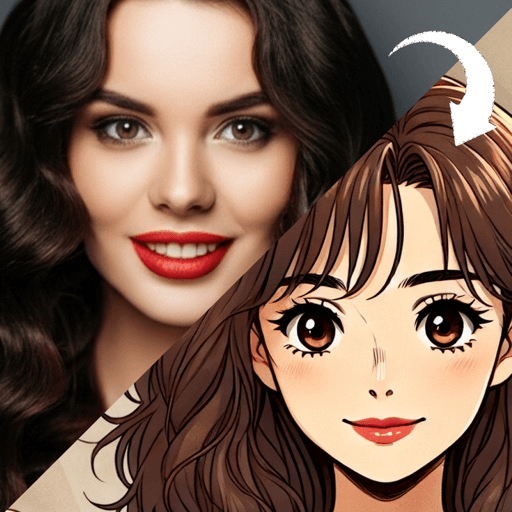
The look
- A single weight of black outline around every shape.
- Flat fills with hard edges instead of gradients.
- A restricted palette of five or six colors across the whole frame.
- Simplified features: dot or oval eyes, a shorthand nose, a drawn mouth line.
- A flat painted background with no depth of field.
Where it comes from
Cel animation is the reason this look exists. Britannica describes the technique as drawing the individual elements of a scene on clear celluloid sheets rather than paper and superimposing them on a single static drawing of the background, which removes the need to redraw backgrounds and stationary objects. The moving parts had to stay simple, outlined and flat so they could be traced and repainted sheet after sheet, while the background, painted once, could carry more detail. Television production pushed that economy further still, and the result hardened into a style: bold outlines, few colors, a held background.
What it suits
- A profile picture with an obvious sense of humor
- Group chat stickers and reactions
- Birthday cards and party invitations
- Print runs such as stickers and tees
How to shoot for it
- Pick one clear expression and commit to it; flat cartoons lose subtlety.
- Use even front lighting, because heavy shadows have nowhere to go in a flat fill.
- Wear one or two solid colors rather than a busy pattern.
- Shoot head and shoulders; a full-body shot shrinks the face below the outline weight.
Related styles
- Pop art portrait: A pop art portrait flattens your face into printed poster color: four or five saturated blocks, a hard black outline, and visible dot texture standing in for skin tone.
- Comic book filter: A comic book filter gives your photo an inked contour, flat printed color inside it, and dot texture through the mid tones.
- Caricature generator: A caricature exaggerates whatever is already distinctive about your face and simplifies everything else.